

In this 2025 guide, we’ll look at how much you can save teaching English in Korea, after tax, insurance and real living costs.
“Can I actually save real money teaching English in Korea?” — this guide is for you.Short answer: with a starting hagwon salary of about ₩2.3–2.5 million per month, free housing, and relatively low living costs, it’s realistic to save roughly ₩1.0–1.5 million per month (around $700–$1,100 USD, depending on the exchange rate) if you’re sensible with money.
Exchange rate note: All USD amounts in this article use a simple working rate of 1 USD ≈ 1,450 KRW. Actual exchange rates change every day, so the dollar figures here are only rough examples, not exact promises.
In this article, you’ll see:
- Typical starting salary for English teachers in Korea in 2025
- Income tax, health insurance, and pension deductions explained simply
- Realistic monthly living costs when your housing is provided
- Example monthly budgets and savings estimates
- How Seoul vs other cities changes the numbers
By the end, you should have a clear picture of what your bank account could look like after a year of teaching English in Korea.
1. Starting Salary for Hagwon Teachers in Korea (2025)
Most first-time teachers in private academies (hagwons) in 2025 are offered:
₩2.3–2.5 million per month (gross) as a starting salary, with higher offers if you have experience, a teaching license, or extra qualifications.
If you are from a country eligible for Korea’s E-2 teaching visa (for example the US, UK, Canada, Australia, New Zealand, or South Africa), you can often start in a hagwon position even without previous full-time teaching experience.
On top of that base salary, most hagwon contracts for foreign English teachers include benefits like:
Free housing
Schools almost always provide a free, semi-furnished studio or one-room apartment, usually within commuting distance of the academy. The school pays the rent directly, so you’re not handing over half your paycheck to a landlord every month. This is one of the biggest reasons teachers can save so much.
Flights / travel support
For overseas hires, most schools either reimburse your one-way flight to Korea after you arrive or provide a fixed travel allowance to help cover your ticket. Some schools also offer a return flight or additional travel support at the end of your contract, but this depends on the individual contract and should not be assumed unless it is written clearly.
National Health Insurance (NHIS)
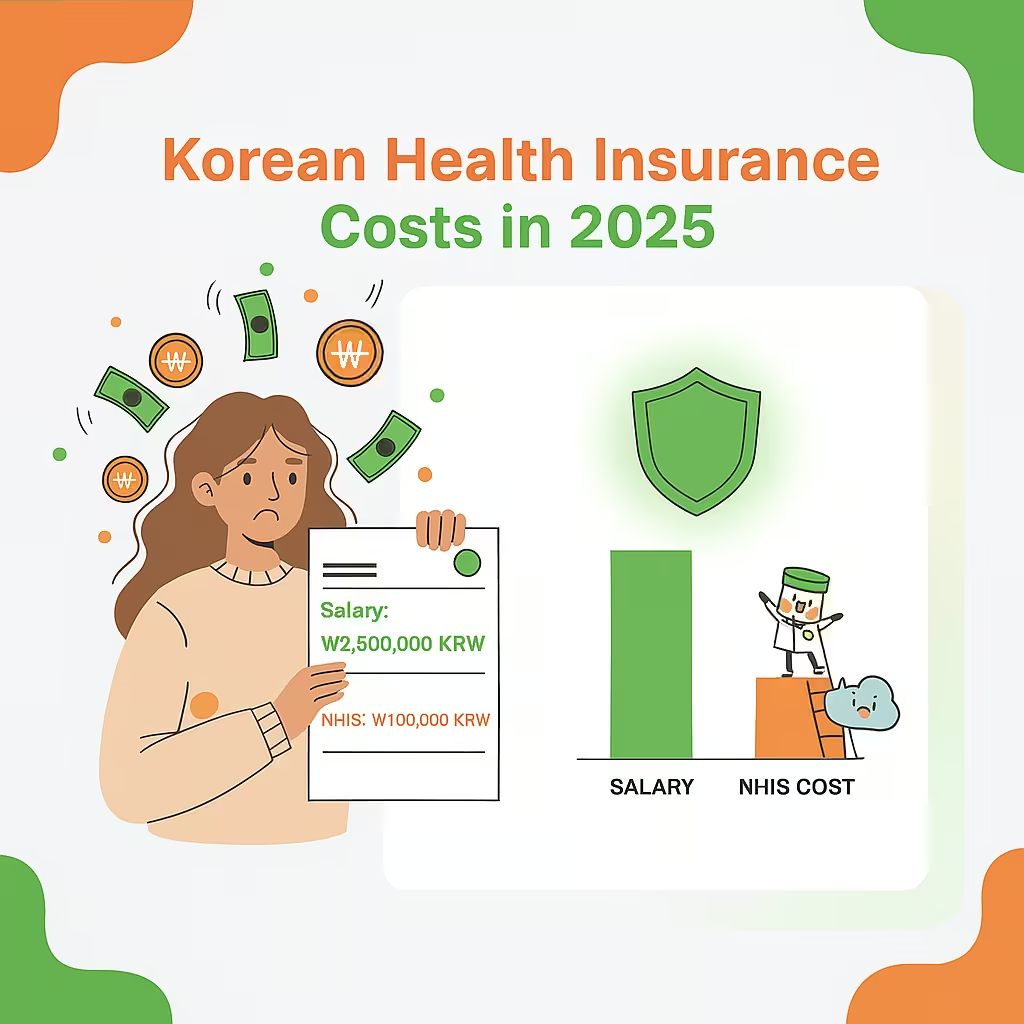
You are usually enrolled in Korea’s public health system. The total NHIS contribution rate is 7.09% of your salary, and this is normally split 50/50 between you and your employer.
That means your personal share is about 3.55% of your salary each month.
In return, you get access to very affordable doctor visits, prescriptions, and hospital care compared to most Western countries.
National Pension (NPS)
The national pension rate is 9% of your salary in total, again split evenly:
- 4.5% paid by you
- 4.5% paid by your employer
For many nationalities, this is not “lost” money. Citizens of countries that have pension agreements or reciprocity with Korea (for example the US, Canada, Australia and several others) can often claim their pension contributions back as a lump-sum refund when they permanently leave Korea, as long as they follow the official process.
Teachers from some countries (for example, South Africa) are generally exempt from the Korean pension system, so they do not have this deduction. Always check your specific situation with the National Pension Service or a trusted advisor, because the rules and eligible countries can change.
Severance pay (bonus month)
When you complete a 12-month contract, you usually receive severance pay equal to one extra month of salary.
This functions like an end-of-contract bonus and is another hidden boost to your savings.
Put together, you have a solid base: a decent salary, free housing, and social insurance. That is the foundation of your savings potential as an English teacher in Korea.
2. What Does Your Korean Teacher Paycheck Look Like After Deductions?
Let’s walk through a simple example for 2025, using a middle value in the usual range:
Example gross salary: ₩2,400,000 per month
2.1. Income tax (national + local)
Korea uses a progressive income tax system. For a first-year teacher with annual income in the ₩27–30 million range, the national tax brackets are 6%, 15%, 24%, and so on. Your income falls mostly in the lower bands.
There is also a local income surtax (sometimes called local income tax) which is generally around 10% of your national tax. When you combine both national and local tax for a typical hagwon salary, the total usually works out to roughly about 3–4% of your gross salary per month.
For our ₩2.4M example, we can use a round estimate:
- Estimated income tax + local tax: around ₩70,000–90,000 per month
The exact amount is calculated by the tax office and reconciled at the end of the year, but this is a realistic working number for planning.
2.2. National Health Insurance (NHIS)
As mentioned above, the total NHIS rate is 7.09% of your salary, split between you and your employer.
Your share is about 3.55%.
For ₩2,400,000:
- ₩2,400,000 × 3.55% ≈ ₩85,000 per month (your contribution)
This gives you access to Korea’s national health system at very reasonable prices.
2.3. National Pension (NPS)
The national pension contribution for employees is 4.5% of salary, matched by 4.5% from the employer.
For ₩2,400,000:
- ₩2,400,000 × 4.5% = ₩108,000 per month (your contribution)
Again, if you are from a country with a pension agreement or reciprocity with Korea, this money may not be “gone forever”. In many cases you can claim a lump-sum refund when you leave permanently.
Always confirm your own country’s status with the National Pension Service.
2.4. Example payslip (approximate)
Putting everything together for our ₩2.4M example:
- Gross salary: ₩2,400,000
- Income tax + local tax (approx. 3.5%): ≈ ₩80,000
- National Health Insurance (≈ 3.55%): ≈ ₩85,000
- National Pension (4.5%): ≈ ₩108,000
Approximate net salary:
₩2,400,000 – (₩80,000 + ₩85,000 + ₩108,000) ≈ ₩2,127,000 per month
In simple terms, for many first-year hagwon teachers earning ₩2.3–2.5M in 2025, it is realistic to expect take-home pay around ₩2.0–2.1M per month after mandatory deductions.
At our working exchange rate (1 USD ≈ 1,450 KRW), ₩2,000,000 is roughly $1,380 USD.
Remember: your pension contributions may later come back to you as a lump sum if you are eligible, which makes your true long-term “net” higher than what you see on your payslip each month.
3. Cost of Living in Korea When Your Housing Is Paid For
Because your school pays for your apartment, your personal cost of living in Korea is much lower than it would be in your home country. Here are the main categories you should plan for.
3.1. Utilities & building fees
In most apartments, you pay:
- Electricity (air-conditioning, lights, appliances)
- Gas (heating, hot water, stove)
- Water
- Building management fee (관리비), if applicable
Season and usage make a big difference. For a one-person apartment near a hagwon, it’s common to spend:
Around ₩100,000–₩150,000 per month on utilities and building fees.
Winter can be more expensive if you use a lot of heating, and summer can be higher if you run the air-conditioner all day.
3.2. Internet & mobile phone
Typical costs for one person in 2025:
- Home internet: about ₩25,000–₩35,000 per month
- Mobile phone plan: about ₩30,000–₩40,000 per month
A simple, realistic budget is:
₩60,000–₩70,000 per month for internet and phone together.
3.3. Food
If you eat like a local, food is one of the best deals in Korea.
- Simple Korean meals (rice, soup, side dishes) in a normal restaurant often cost
₩6,000–₩8,000. - Street food and kimbap shops can be cheaper, especially for quick lunches.
- Groceries are reasonable if you buy Korean basics (rice, eggs, vegetables, tofu) and don’t rely heavily on imported products.
A realistic monthly food budget for one person, mixing home cooking and eating out, is:
₩250,000–₩350,000 per month
If you buy a lot of imported snacks, wine, or cheese, your food budget will rise quickly. If you enjoy Korean food and cook at home regularly, you can stay near the lower end of this range.
3.4. Transportation
Public transportation in Korea is extremely efficient and affordable. You usually do not need a car.
- One subway or bus ride: about ₩1,250–₩1,500
- Many teachers who commute by public transit spend around ₩40,000–₩70,000 per month.
If you live very close to your school and walk most days, your monthly transportation costs can be even lower.
3.5. Personal spending (fun & extras)
This category depends completely on your lifestyle. It can include:
- Cafés and desserts
- Bars, clubs, and nights out
- Shopping (clothes, cosmetics, gadgets)
- Hobbies (gym membership, sports, games, language classes, etc.)
A modest but comfortable “fun money” budget might be:
₩150,000–₩250,000 per month
If you go out drinking every weekend or travel frequently, this number will be higher. If you are more home-focused, it can be lower.
4. Example Monthly Budgets and Savings Estimates
Now let’s combine salary and expenses to see how much you might actually save.
We’ll use a simple working example:
- Net income: ₩2,100,000 per month (after typical deductions)
Scenario A – “Normal” lifestyle, still saving well
In this scenario, you go out on weekends, eat out regularly, and take the occasional trip, but you’re not spending aggressively every day.
- Net pay: ₩2,100,000
- Utilities + building fees: ₩130,000
- Internet + phone: ₩70,000
- Food (mix of cooking & eating out): ₩320,000
- Transport: ₩60,000
- Personal / entertainment: ₩220,000
Total monthly spending:
130K + 70K + 320K + 60K + 220K = ₩800,000
Approximate savings:
₩2,100,000 – ₩800,000 = ₩1,300,000 saved per month
At 1 USD ≈ 1,450 KRW, that’s roughly $900–$1,000 USD per month in savings.
Scenario B – “Frugal but not miserable”
In this scenario, you still enjoy life, but you cook at home more often, limit bar nights, and avoid expensive impulse purchases.
- Net pay: ₩2,100,000
- Utilities + building fees: ₩120,000
- Internet + phone: ₩60,000
- Food (more home cooking): ₩260,000
- Transport: ₩50,000
- Personal / entertainment: ₩150,000
Total monthly spending:
120K + 60K + 260K + 50K + 150K = ₩640,000
Approximate savings:
₩2,100,000 – ₩640,000 = ₩1,460,000 saved per month
That’s roughly $1,000+ USD saved every month under our working exchange rate.
Over a 12-month contract, even Scenario A can easily mean:
- ₩15–16 million in savings (around $10,000–$11,000 USD)
- plus one extra month of salary as severance
- plus a potential pension refund if you are eligible
This is why so many teachers come to Korea with student loans or no savings and leave with a solid financial cushion.
5. Seoul vs Other Cities: Where Do You Save More?
So far we have talked about national averages and a fairly typical lifestyle. Location still matters a lot.
Living and working in Seoul
Seoul is the most expensive city in Korea:
- Restaurants, bars, and cafés are usually more expensive than in smaller cities.
- Imported goods and nightlife can quickly increase your monthly spending.
- If your school gives you a housing allowance instead of a free apartment, rent can be very high in central areas.
Living and working in other cities
In cities like Busan, Incheon, Daegu, Daejeon, Gwangju, and many mid-sized towns:
- Everyday prices for food and entertainment are often lower.
- Local restaurants and cafés can be significantly cheaper than in Seoul.
- Your free housing benefit goes further in areas where rent would normally be lower.
If your main goal is saving money, a smaller or mid-sized city can sometimes be a better choice than central Seoul, because your cost of living is naturally lower while your salary may be similar.
For a deeper, city-by-city breakdown of Korean living costs, including Seoul and other major cities, take a look at:
Korea City Costs 2025 – Living Expenses by City
6. Why Is It So Much Easier to Save in Korea Than at Home?
Here are the main reasons many English teachers say Korea is one of the best countries in Asia for saving money:
- Your biggest expense (rent) is already paid.
In the US, UK, Canada, Australia, New Zealand, South Africa and other countries, rent can easily swallow 30–50% of a starting salary. In Korea, your apartment is usually part of your benefits package, which effectively gives you hundreds of dollars of value every month. - Public health care is affordable with NHIS.
You are not paying hundreds of dollars for private insurance every month. Your NHIS contribution is a small percentage of your income and is shared with your employer. - Transportation is cheap and efficient.
You usually do not need a car, car insurance, or fuel. Subways and buses can take you almost anywhere you want to go. - Food can be very inexpensive if you stick to local options.
If you enjoy Korean food and cook a bit at home, your food costs stay low without feeling like you are “suffering”. - Pension and severance add hidden extra savings.
Pension refunds (for eligible nationalities) and the extra severance month effectively increase your true annual income beyond the monthly salary.
Put simply, Korea lets you live decently and still save a lot, even on an entry-level salary — something that is very difficult in many Western cities today.
7. Final Thoughts: Is Teaching English in Korea Worth It Financially?
If your main goal is to pay down student loans, build an emergency fund, or save for travel, teaching English in Korea is still one of the strongest options in 2025.
- Starting hagwon salaries have moved up into the ₩2.3–2.5M range for many first-time teachers.
- Social insurance (health and pension) does reduce your monthly take-home, but it gives you real protection and long-term benefits.
- With housing covered and normal spending habits, it is realistic to save ₩1.0–1.5M per month, even as a new teacher.
If you want help finding schools that actually offer these conditions — not just promises in an online ad — that is exactly what OK Recruiting has been doing for international teachers since 2006.
■ Korea City Costs 2025 – Living Expenses by City
■ For more details on visa types and requirements, see our main guide: Teach in Korea – Requirements & Visa Guide.
■ If you’d like us to match you with schools that fit your goals, you can apply through OK Recruiting here.